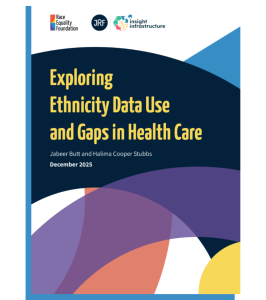
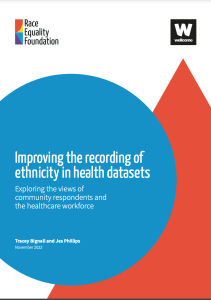
Advancing Racial Justice: Convention on the State of Data 2026
Thursday 16 April, 9:30am – 5pm | Euston, London
A joint conference by the Race Equality Foundation, the Centre on the Dynamics of Ethnicity, and the Joseph Rowntree Foundation on racism, inequality, and inclusive data.
The Race Equality Foundation, in partnership with the Centre on the Dynamics of Ethnicity (CoDE) and the Joseph Rowntree Foundation (JRF) hosted a landmark convention in April 2026 to explore how data is used to understand racial inequality in the UK, and what must change to better support racial justice work.

The challenge
We know that racism and racial inequality in UK society continues to shape outcomes across health, education, housing, employment and social care, and influences how data is collected, interpreted and used, often determining whose experiences are recognised and acted upon.
Data is a vital part of the infrastructure that allows us to understand the nature, scale, and impact of racism and racial inequality. In recent years, research, lived experience, and voluntary, community and social enterprise (VCSE) led interventions have utilised ethnicity data to expose the extent and impact of racism. The EVENS survey and the EVENSinACTION initiative have also pioneered improvements to ethnicity data infrastructure, and to drive racial justice work.
However, many of the solutions to improve the data infrastructure have struggled to gain traction in policymaking and institutional practice, while significant gaps in ethnicity data continue to obscure the nature and scale of racial inequality.
About the Conference
This joint one-day conference aimed to advance sector-wide efforts to use ethnicity data as a tool for racial justice. By bringing together evidence, lived experience and decision-makers, we aimed to deepen understanding of how racism persists across UK society and showcase the range of emerging data-driven solutions to tackle it.
The conference created a space for reflection, shared learning and agenda-setting across sectors on how data can drive meaningful action on racial inequality, and what must change to strengthen its impact.
Together we:
- Examined the current state of data and evidence used to expose and address racial inequality
- Identified gaps, exclusions and structural barriers in how data is collected, interpreted and funded
- Centred lived experience and community-led research alongside quantitative evidence
- Connected policymakers, researchers, funders and VCSE leaders to shape priorities for future action
Collaboration and Partners:
Resources and Evidence

Not just numbers: the importance of ethnicity data to Europe’s past, present, and future
Gary Younge | University of Manchester In her biography of Harlem Renaissance writer Zora Neale Hurston, Valerie Boyd explains why it was so difficult to track Hurston’s whereabouts during the novelist’s early twenties. “In 1911 it was relatively easy for someone, particularly a black woman, to evade history’s recording gaze,” [...]

Making Sense of Poverty Data: Building a Better Picture of Inequality in the UK
Aleks Collingwood, Partnership Manager at the Joseph Rowntree Foundation, writes on the challenges of understanding poverty and inequality in the UK with the current limitations in socio-demographic datasets. The blog both identifies the consequences of data gaps, and what is needed to ensure greater access to high-quality inclusive data capable of driving social justice efforts.

Community co-production for more racially inclusive survey data
Nissa Finney, founding member of the Centre on the Dynamics of Ethnicity, explores the importance of community involvement and co-production in creating racially inclusive datasets.

Limitations of ONS Life Expectancy Estimates for minoritised ethnic groups in the UK
Dharmi Kapadia, Senior Lecturer at University of Manchester, and Director at the Centre on the Dynamics of Ethnicity, presents research carried out alongside Harry Taylor and Laia Becares (King’s College London) on the limitations of ONS life expectancy estimates published in 2021.