Racialised and gendered violence is in critical need of being recognised as a public health crisis.
The UK’s 2024 racist riots revealed the devastating consequences of unchecked racialised and gendered violence. These events were not isolated, but the result of longstanding inequalities, misinformation, and systemic failures. Our report, ‘Understanding the Racist Riots of 2024 and What Should Be Done’ (2025), identified the urgent need for a public health approach that specifically addresses the racialised and gendered nature of serious violence.
We have received funding from People’s Health Trust to create a UK public health approach to violence prevention that foregrounds racial and gender equity, building on the ecological model for violence prevention developed by the World Health Organisation (WHO).
Key Outputs
A Public Health Model for Preventing Racialised and Gendered Violence – an adapted version of the WHO model that focuses on the UK and explicitly integrates racism and gender inequality as structural drivers of violence, drawing on the ecological framework (individual, relationship, community, and societal levels) with equity and intersectionality as core principles.
An implementation Guide and Toolkit – Practical guidance for local authorities, NHS bodies, Violence Reduction Units, and VCSE organisations on how to apply the model at local and national levels, including tools for commissioning, workforce development, and partnership structures.
A National Coalition – A coalition of partners and expert advisors positioned to sustain the work and support implementation and evaluation.
Methodology
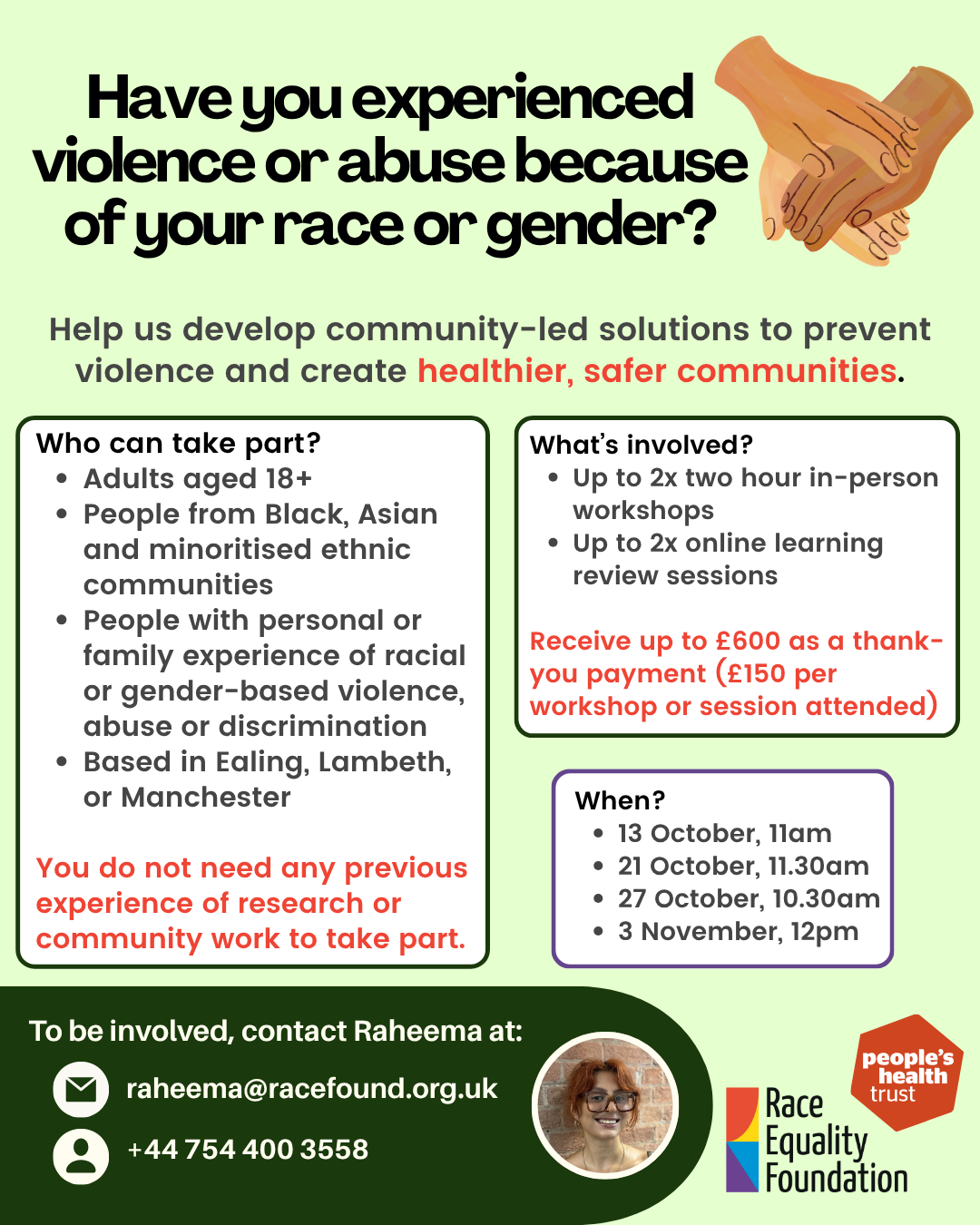
The project consists of two phases of participatory action research: the development of the model, followed by pilot testing in Ealing, Lambeth and Manchester. We have recruited 24 participants with lived experience of racialised and/or gendered violence through purposive sampling.
Creative and participatory methods are being employed across both phases, including place-based mapping, body mapping and photo elicitation. We are also using learning reviews and feedback loops across both phases to record how interpretations, priorities and the model change throughout the work. The analysis is being co-produced with lived-experience participants and informed by evidence from community and system contributors.
Further reading and resources
Responding to the racist riots project page
Understanding Racialised and Gendered Violence in the UK: An Evidence Review
If you, or someone in your network, would like to contribute to this important work, we encourage you to find out more and apply. For further information, please contact Raheema Khan, Policy Officer.