Dr Rob Berkeley MBE | Director, BLKOUT UK
It is Pride month: logos turn rainbow, statements turn warm, and somewhere, a marketing team is congratulating itself on the diversity of its stock photography. There is a different visibility I want to talk about – the one that decides whether Black queer men in this country live or die.
On 14 May, the UK Health Security Agency (UKHSA) published its annual HIV report. Headline new diagnoses are down. Look beneath the headline, though, and the gain is not evenly distributed: among ethnic-minority gay and bisexual men the rate of decline is roughly a third of the pace seen in the overall population. Kevin Fenton wrote about this over the bank holiday weekend, and it is worth saying plainly – we already knew. I sat on the 2020 HIV Commission. The argument I pressed then, which the final report bears, was that we would not reach zero new transmissions by 2030 unless the response was racially equitable. Five and a half years on, the data has caught up to the argument. This is not an occasion to be pleased that a prediction came true.
This is the visibility that matters. Not whether your high-street bank’s logo went rainbow on 1 June, but whether the systems built to keep you alive can see you at all.
Visible to whom, for what
Visibility is not one thing. There is the visibility of celebration – being seen at a parade, on a poster, in a press release. And there is the visibility of accountability – being counted in a dataset, named in a strategy, or tracked in an outcome.
For Black queer men in the UK, those two visibilities point in opposite directions. We are hyper-visible in the first sense – aestheticised, marketed to, photographed at the front of campaigns when funders need a face. We are systematically invisible in the second – under-disaggregated in NHS data, under-named in race equality strategies, and under-counted in the LGBTQ+ statistics that drive resource allocation.
The compound identity that should make us more legible to public services makes us harder to find in their data. Race equality monitoring tends to be single-axis. Sexual-orientation monitoring tends to be single-axis. The intersection falls through the gap between forms.
That gap is not an accident of administrative convenience. It is a political choice about whose suffering counts as evidence.
Data invisibility is a political problem
The temptation in our sector is to treat data gaps as a comms challenge. We need to tell the story better. As if the silence were a marketing failure. The gap is upstream of any story we might tell – in the question we never asked, the box we never provided, the analyst we never funded to disaggregate the numbers we did collect.
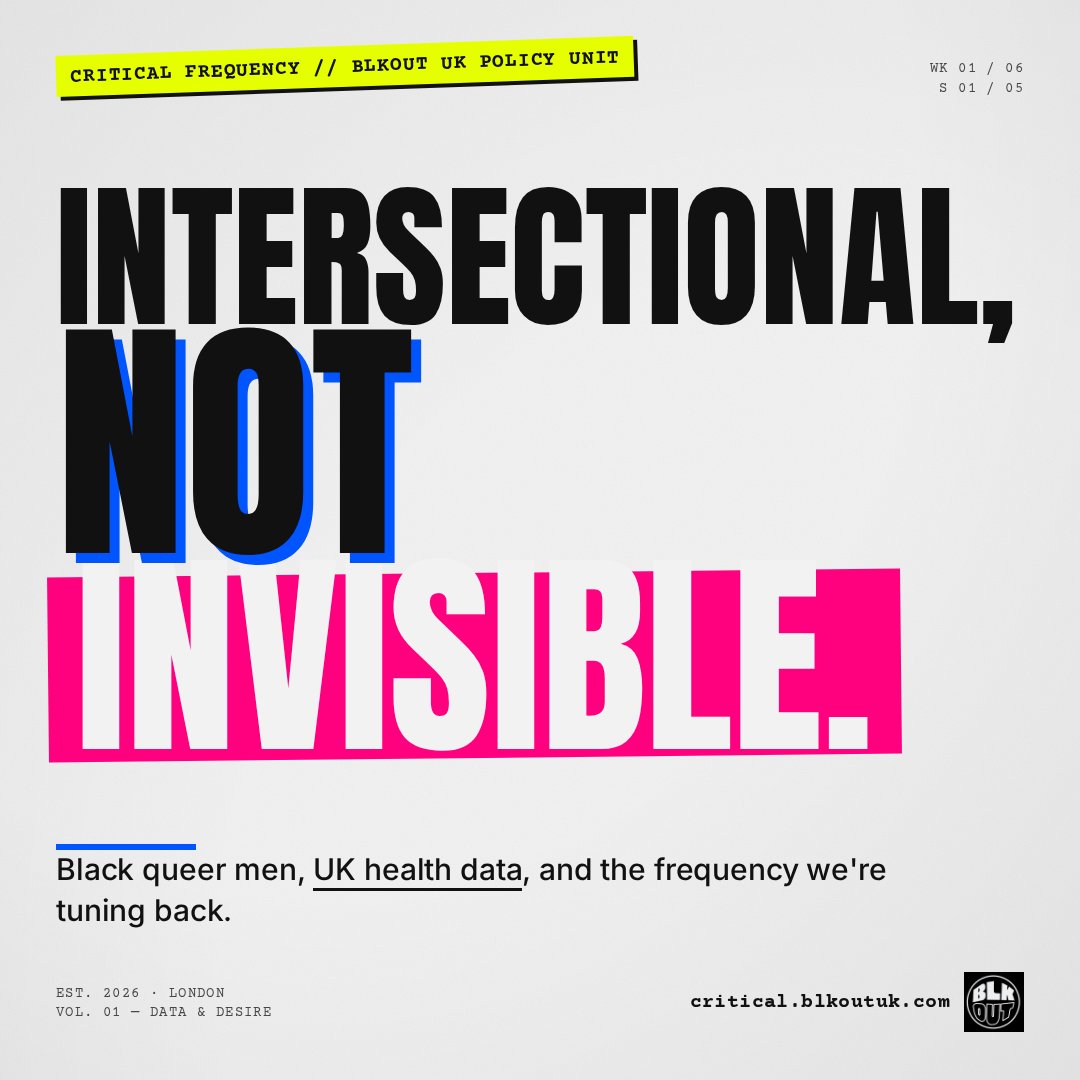
At BLKOUT – the community-owned cooperative I help to lead – we have been quietly building Critical Frequency: an attempt to take this seriously as a problem of methodology and power, rather than of communication.
The Public Sector Equality Duty makes intersectional analysis a legal requirement, not a methodological preference. The Race Disparity Audit, the LGBT Action Plan, the Race and Health Observatory’s programmes – all of them sit on top of data infrastructure that was not designed to render compound identities visible. Adding intersectional analysis after the fact is more expensive than building for it. It is also slower. People die in the gap.
So when I read UKHSA’s third-pace decline among ethnic-minority gay and bisexual men, I do not see a comms problem. I see what happens when a public health response is built for the population that is easiest to count.
What race equality work can do with Pride
Pride is the moment when the sector’s attention turns, briefly, to queer life. Race equality colleagues have a chance to do something with that attention that the queer sector alone cannot.
So – first, go and look at what community-led data infrastructure actually looks like on critical.blkoutuk.com. Critical Frequency is the programme we are building to close exactly the gap UKHSA’s data has laid bare: designed and led by and for Black queer men, network-positioned rather than queue-based, treating community ownership of evidence as the methodology rather than the wrapper.
Spend ten minutes there before you finish reading this piece.
Then go and look at your own. In every dataset you commission, fund, or publish, ask whether it can be disaggregated by ethnicity and sexual orientation and gender identity together. If a survey instrument captures one but not the other, ask why. The same applies in reverse, and we should be asking it of the LGBTQ+ organisations taking race equality money. Most race equality bodies monitor race for staff and beneficiaries; few cross-tabulate by sexual orientation. The audit is straightforward. The result tends to be revealing.
The visibility we should want
The point of being seen is not to be celebrated. It is to be counted, served, and protected. The first kind of visibility is cheap – rainbow logos cost nothing. The second costs money, methodology, and political will. Race equality work has all three. Pride is a good month to use them.
We do not need more statements about Black queer men. We need data infrastructure that can see us when the next epidemic – or the slow current one – comes asking who lives.